At Green IO London, I ran a workshop on DIST. DIST stands for Digital Impacts Schema and Taxonomy. It’s an open source project I created with Hannah Smith, Tim Cowlishaw and Fershad Irani, stewarded by the Green Web Foundation. Chris Adams has also written a clear introduction.
Why we built it
Many organisations want to understand the impact of their technology, but the numbers are hard to get and everyone reports them differently. Chris points out that few people deeply understand both sustainability and technology. DIST means that when you’re asked to work out your numbers, you’re not starting from scratch.
What it is
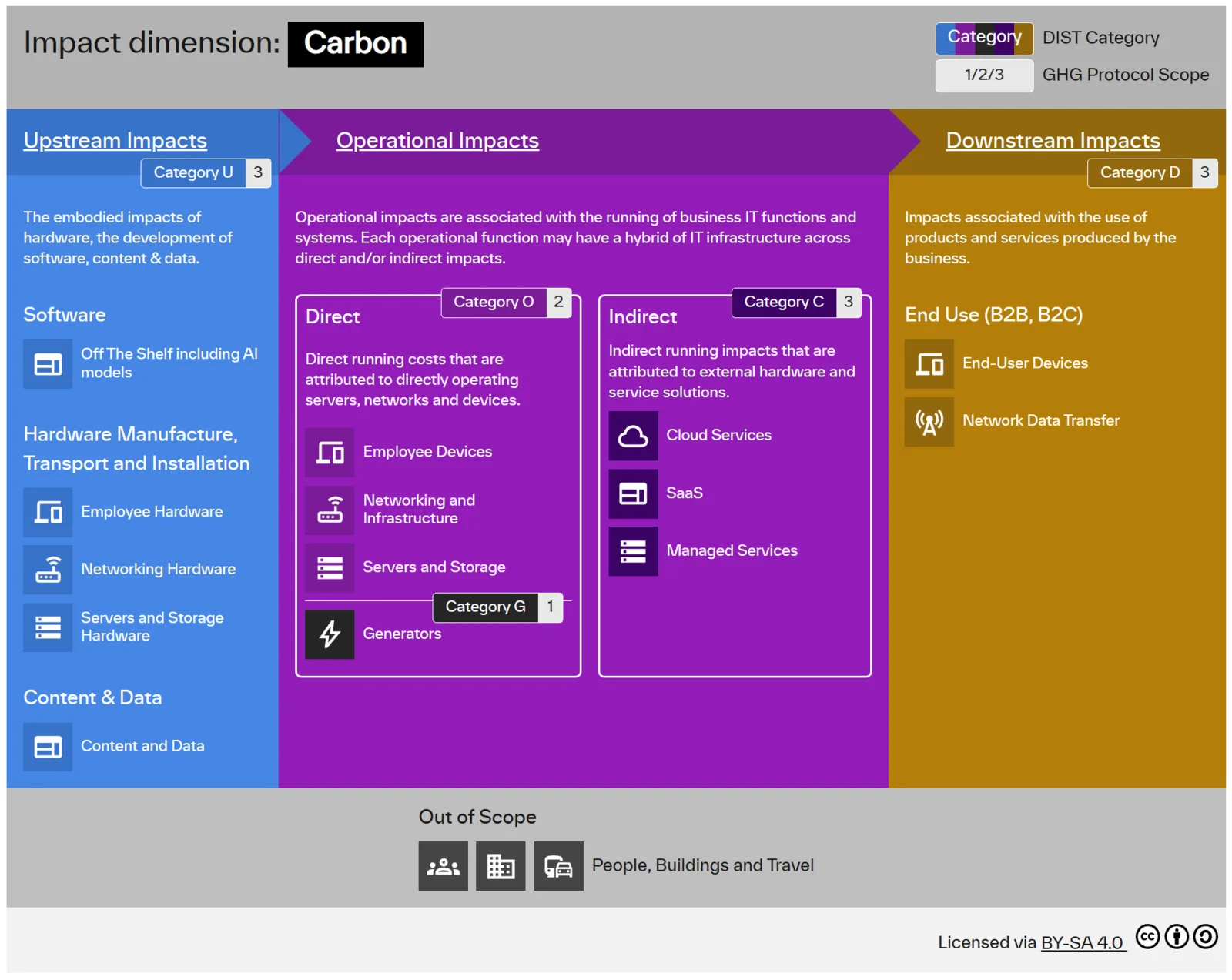
We have a Taxonomy (pictured below), a Methodology Map, and a Schema, which are designed to work together.
Taxonomy: a checklist covering the whole life of technology, so nothing important gets missed. This was the heart of the workshop.
Methodology Map: a curated list of ways to measure or estimate each type of impact.
Schema: an agreed layout for sharing your data, so people and software read it the same way. It shows how you got your numbers, not just what they are.
Today, supplier impact data often arrives as a PDF or not at all. A shared format makes comparison possible.
It’s all open. Explore the site and GitHub repo, or raise ideas on GitHub as issues (links below).
If you build tools that estimate digital impacts, or know a method we are missing, we’d love to hear from you. We are also keen to hear from those who’d like to contribute to other dimensions beyond carbon.
Thanks again to Hannah Smith, Chris Adams, Tim Cowlishaw, Fershad Irani and everyone else at the Green Web Foundation who has supported this work.
Also to Gaël Duez and Sandra Sydow for fitting me into the agenda not once but twice!
Links
- Slides and more details of the talk
- Chris Adams’s introduction to DIST
- DIST website
- DIST on GitHub, where you can share feedback as issues, or view and collaborate on the work if you want to get more involved